

ANTAQ reviews container demurrage and detention: what it proposes for forwarders, NVOCCs, importers and exporters.
Before we begin
At the firm, we read Brazil's Official Gazette, the regulators' releases and the new court rulings every morning. Much of what matters to anyone moving cargo through Brazil passes there quietly, and only becomes a topic once it has become a cost.
The tariff that took effect yesterday. The public consultation deadline nobody mentioned. The fine a court has just struck down and your assessment still charges.
I decided to stop saving this for meetings. This newsletter is what we read in the morning, with our view of what it changes for importers, exporters and freight forwarders.
It grows out of the conviction that drives our firm: anyone doing business across Brazil's borders needs legal partners who see the risk before it becomes a loss. That is how our team works, anticipating what changes in the law, at the port and at customs so that our clients can decide with confidence.
We hope this reading serves your business well.
Best regards,
ANTAQ, Brazil's waterway transport regulator, has published its preliminary Regulatory Impact Assessment (AIR) on container demurrage and detention and is taking comments under Public Consultation SRG No. 03/2026 until 23:59 Brasília time on 20 October. The recommended option for revising ANTAQ Resolution No. 62/2021 defines key terms and lists prohibited conduct. On the point that weighs most on freight forwarders and NVOCCs, it would bar intermediaries from cutting free time and from charging a "mark-up" on demurrage without a "triggering event", with a specific penalty (item 10.15). The report does not recommend a regulated minimum free time.
We read the proposal through the Specific Logistics Function Theory (Teoria da Função Logística Específica) developed by Dr. Fábio Gentil: in the transport chain, liability follows the specific function each party performs and the sphere of obligations that function carries, not the position it holds on the bill of lading. The method has three steps: isolate the concrete obligation, identify the function actually performed, and check whether that obligation falls within that function. This is the test that shows why the rule proposed for intermediaries is not a mere pricing detail.
The report's premise is that demurrage is not payment for a service (item 4.82). From this it concludes that an intermediary could not charge more than the carrier or grant less free time (item 4.84). It also restates that an intermediary passing on the charge must show the amounts actually billed by the carrier (ANTAQ Ruling No. 521/2025, understanding 5.1.9). Among the conduct to be penalised, it lists the failure to separate the "amount of the reimbursement" from the "amount of the intermediation". In the agency's logic, the freight forwarder is a pass-through: it hands the carrier what the carrier charged.
The detail that seems to go unnoticed is that to pass something on, you must first receive it.
If ANTAQ adopts this premise, the consequences go beyond pricing. Whoever merely passes a charge on is not the debtor of that charge: an intermediary is an intermediary. Demurrage arises from holding the container beyond free time, and the duty to return it lies with whoever holds the cargo and the container. Under this model, the freight forwarder is no longer the direct debtor before the carrier, even where it has issued a house bill of lading (it would, after all, be a "pass-through"). Taken seriously, the pass-through logic also shakes liability for loss and damage: if the forwarder is a mere pass-through vis-à-vis the carrier, how can the NVOCC and the forwarder that issues a house bill be treated as carriers, even contractual ones, vis-à-vis the cargo owner? The report itself defines the NVOCC as the party that takes responsibility for the carriage (item 4.77). The contradiction lies in the premise, not in the forwarder. The forced joint liability that carriers' bills of lading impose through the Merchant clause would also be directly affected. Under Brazilian law, joint liability is not presumed; it arises from statute or from the will of the parties (article 265 of the Civil Code). A standard-form clause cannot create it where the function does not carry the obligation.
If, on the other hand, the freight forwarder continues to answer to the carrier as shipper or consignee, for what can properly be demanded of that function, it is only natural that it should have its own tariff. That is the position the report itself recognises for the NVOCC, which issues the house bill and subcontracts the carrier (item 4.77). For a party in that position, the loss caused by container retention is not limited to what it pays the carrier: it adds the losses the retention causes the forwarder itself. And if the carrier's demurrage is liquidated damages that require no proof of loss, as many argue, so is the forwarder's. That is the triggering event the recommended option requires for a difference between tariff bases. What cannot stand is combining the two positions, treating the forwarder as a pass-through when it charges demurrage and as contracting party and direct debtor when it has to pay.
The logic must be the same on both sides. If the forwarder has to disclose how its demurrage tariff is built, the carrier will also have to prove how its own is built. The asymmetry already appears in the report. When it rejected a price cap on demurrage, ANTAQ's board relied on free negotiation between the parties (Ruling No. 635/2025, cited in item 4.102). Item 4.84, however, makes the carrier's amount the ceiling and the carrier's free time the floor for intermediaries. Without symmetry, the forwarder answers for the carrier's full amount, cannot price its own risk and becomes the universal guarantor of importers and exporters. A relationship that is already unbalanced would become even more perverse.
Then there is the question of competence. Brazil's Constitution gives the Union exclusive power to legislate on civil, commercial and maritime law (article 22, I), a provision the report itself lists among the bases for the agency's action. Law No. 10,233/2001 empowers ANTAQ to issue rules on the provision of transport services, protecting users' rights (article 27, IV), and provides that authorised operators work under freedom of pricing for services, tariffs and freight (article 43, II). Requiring transparency and penalising abusive charges fit within that framework. Deciding who is the debtor of an obligation between private parties, what its nature is and how much one private party may charge another is a matter of civil and maritime law. We would stress that the nature of demurrage is being debated right now in Brazil's Superior Court of Justice (STJ), which remains divided between damages and a contractual penalty. There is a serious argument that the resolution, on this point, would exceed the agency's regulatory remit and encroach on the legislature's domain.
For exporters and importers, the report consolidates progress. ANTAQ's board has already ruled that vessel delay is the carrier's risk. It has also ruled that no demurrage is due when the extra time results from a failure of the carrier, of the terminal it designated or of the empty container depot (Ruling No. 578/2025). And it has ordered a responsibility matrix for the lack of delivery slots at terminals (Ruling No. 56/2026). The report further states that the return of an empty container cannot be blocked by a logistics problem at the depot designated by the carrier (item 4.58).
Our take
forwarders, NVOCCs, importers and exporters, who deal with demurrage and detention every day, should not miss this chance to take part and to keep regulation from worsening a problem that has only grown over the past 20 years.
In numbers
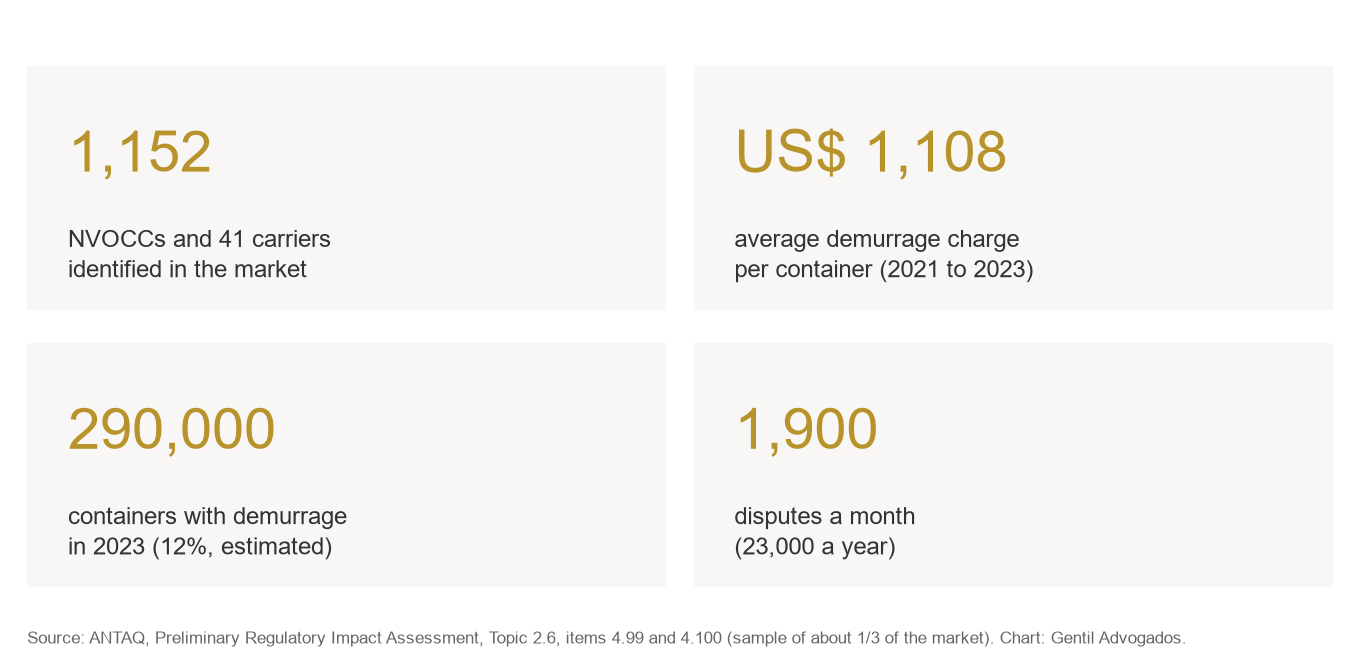
- 1,152
- NVOCCs and 41 carriers identified in the market
- US$ 1,108
- average demurrage charge per container (2021 to 2023)
- 290,000
- containers with demurrage in 2023 (12%, estimated)
- 1,900
- disputes a month (23,000 a year)
In ANTAQ's sample, demurrage and detention charges exceed R$ 960 million a year. Projected across the whole regulated market, they pass R$ 3 billion (item 4.99). That is the size of what is at stake in the review.
Sources
- ANTAQ, Relatório de AIR Preliminar do Tema 2.6 (SEI 3002403)
- ANTAQ, Aviso de Tomada de Subsídios SRG nº 03/2026
- Fábio Gentil, "Booking não é destino" (Teoria da Função Logística Específica)
What changed
Federal appeals court: customs cannot hold goods to collect a disputed classification difference
Federal appeals court
The TRF1, a federal appeals court, ruled unanimously that customs cannot hold goods at clearance to collect the extra tax from a tariff reclassification that the importer has already challenged administratively. While the challenge is pending, the claim is suspended and the cargo must be released. The judgment is dated 8 September 2026.
Gentil reading: If your cargo is held over a classification dispute and you have already challenged the claim, cite the judgment when seeking release, without payment or a guarantee. The tax authorities usually rely on the Supreme Court thesis allowing clearance to be conditioned on paying a difference assessed by customs; the judgment answers that it does not apply once the claim is under administrative challenge.
Source: TRF1, Apelação/Remessa Necessária nº 1016402-61.2020.4.01.3400 (inteiro teor via ConJur; CTN, art. 151, III; STF, Tema 1.042); ConJur
Tax appeals board: ties between parties are not enough to prove fraudulent interposition
Tax appeals board
CARF, the body that hears administrative appeals against federal tax assessments, ruled by majority for the taxpayers in a fraudulent interposition case involving imports. In its view, circumstantial evidence can prove that the real buyer was concealed, provided it is sufficiently consistent and convergent; ties between the companies, sales concentration and margins are not enough on their own. The decision was published on 30 September 2026.
Gentil reading: If your company was assessed for interposition based only on ties, customer concentration or margins, use the headnote to demand concrete proof from the tax authorities that the real buyer was concealed. The same applies to parties named jointly liable merely for trading with the importer.
Source: CARF, Acórdão 3401-015.032
US: CBP sets out how to claim refunds of the IEEPA tariffs struck down by the Supreme Court
United States
The US has set out how to refund the tariffs imposed under the International Emergency Economic Powers Act (IEEPA), which the Supreme Court struck down on 20 February 2026. They amount to some US$ 166 billion, collected between February 2025 and February 2026. Claims are filed by the importer of record, or the broker it designates, on the US Customs and Border Protection (CBP) portal.
Gentil reading: If your company sold into the US as importer of record (under DDP terms, for example) between February 2025 and February 2026, check now your access to ACE, the CBP portal, and the bank details on file. In other sales the money goes back to the US importer, and it is worth raising in the next price negotiation.
Source: Federal Register, 91 FR 63299 (5/10/2026); CBP, IEEPA Duty Refunds
EU audit clears Brazil's controls for poultry and honey, but Brazil remains off the list
European Union
A European Commission audit concluded that Brazil's controls on the use of certain antimicrobials are a sound basis for certifying poultry meat and honey. Brazil nevertheless remains off the list of countries authorised to export these products to the EU. Consignments certified since 3 September 2026 therefore still cannot enter.
Gentil reading: A favourable report does not reopen the market by itself: resumption depends on the EU publishing the act that puts Brazil back on the list. Until then, do not certify or ship cargo on the assumption of resumption, and build that gap into contracts with European buyers.
Source: Comissão Europeia, relatório DG(SANTE) CT-2026-0202 (Regulamento de Execução (UE) 2021/405, Anexo XVIa); Agence Europe; The Poultry Site / ABPA
Calendar
- 5-7 Oct
- Meeting of ANTAQ's board, held electronically, 14:00 on 5 October to 17:00 on 7 October, Brasília time
- 8 Oct
- ANTAQ webinar on the review of its container demurrage and detention rule, 15:00 Brasília time, YouTube
- 8-9 Oct
- EU Trade Commissioner Maroš Šefčovič in Beijing for the EU-China Trade and Investment Council (according to AFP)
- 16 Oct
- Deadline to give notice of intent to participate in the US review of the anti-dumping order on Brazilian aluminum foil, which decides whether the order stays (US Department of Commerce)
- 20 Oct
- Deadline for comments to ANTAQ on container demurrage and detention, 23:59 Brasília time
- 29 Oct
- Meeting of Gecex, the committee of Brazil's Foreign Trade Chamber (Camex) that sets import tariffs, 09:30 Brasília time
- 31 Oct
- Last day to request administrative review of the US orders on Brazilian steel wire rod
- 2 Nov
- Responses due at the US International Trade Commission (USITC) in the Brazilian aluminum foil review, by 5:15 p.m. Washington time
- 4 Nov
- Comments due on the CBP notice on IEEPA tariff refunds
- 9 Nov
- End of the suspension of US port fees on China-linked vessels, 11:59 p.m. New York time; no extension published as of 3 October
- 4 Dec
- Comments due to the US Federal Maritime Commission (FMC) on its complaints and mediation portal
Read in: Português · Español
All issues (Portuguese archive) · Subscribe to the newsletter · RSS